

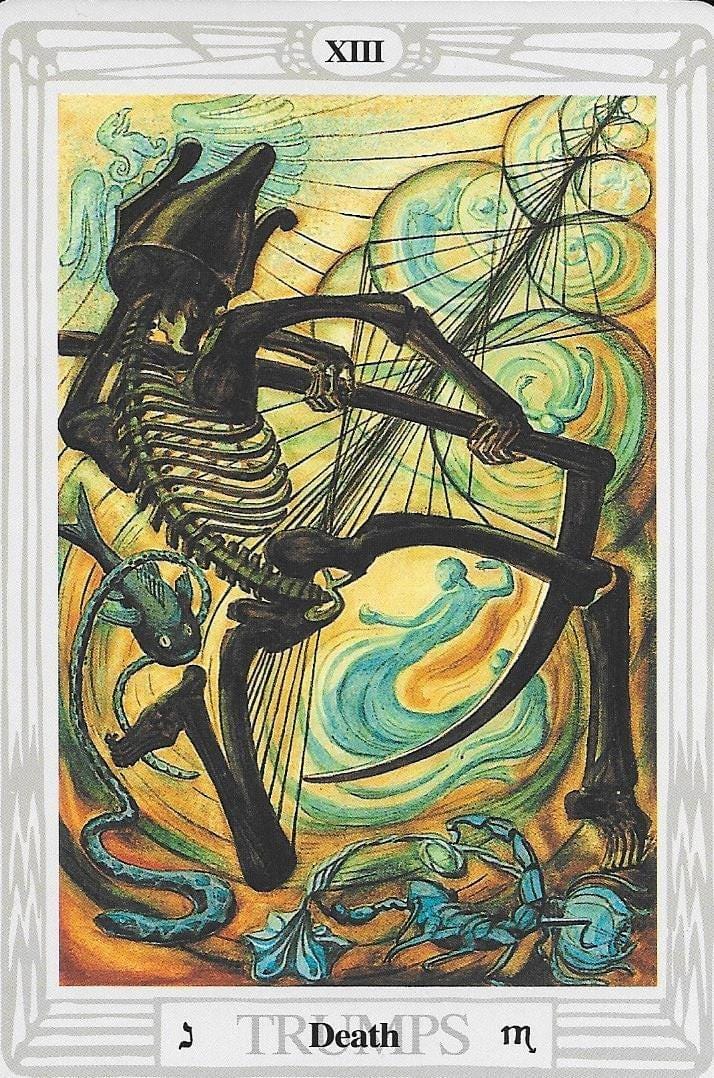
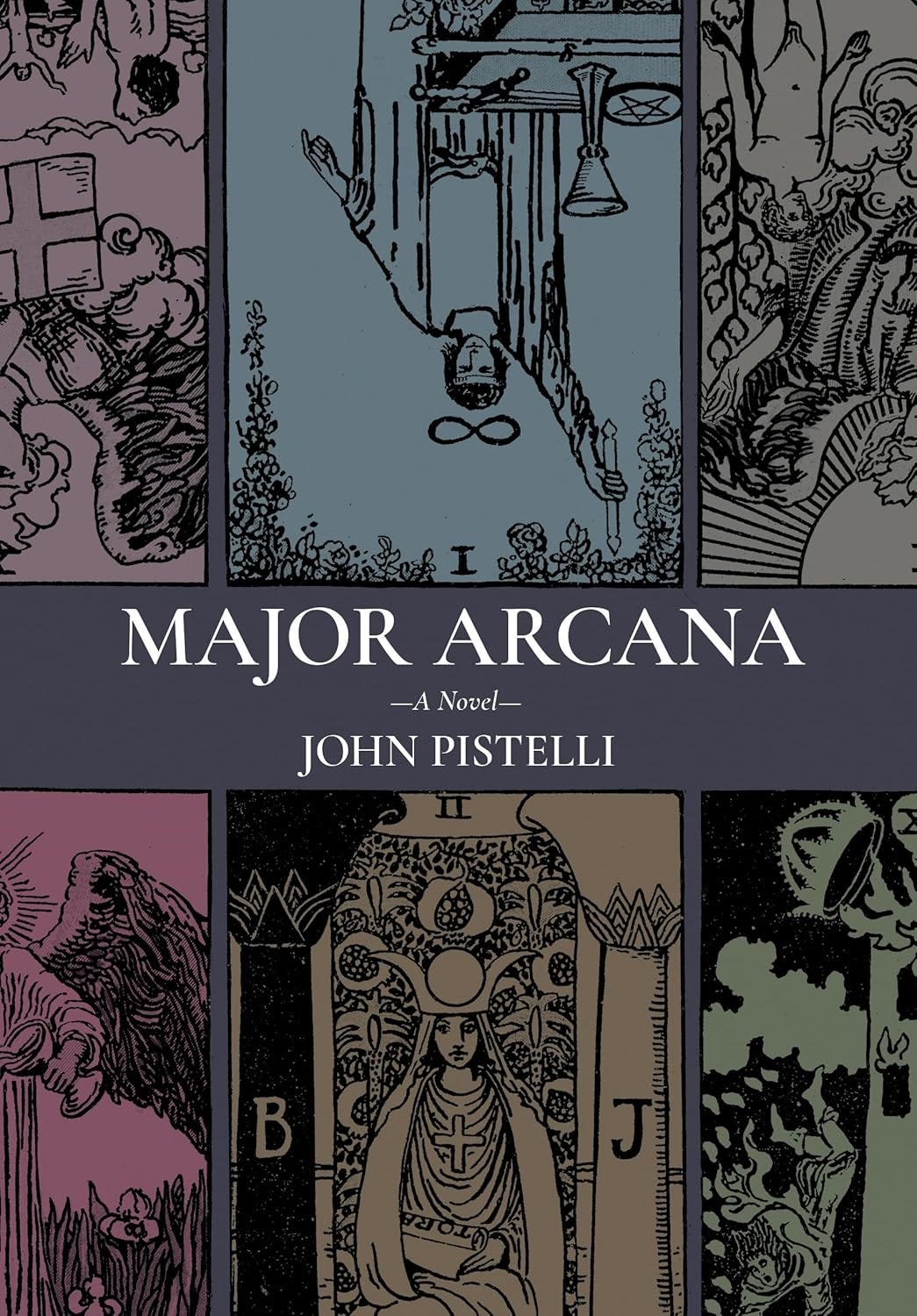
Certain books in the Write Conscious schedule have been like pulling a tarot card. By reading them and projecting my life onto their stories, I’ve been able to see my own reality from another point of view, somewhere just beyond the threshold of my everyday patterns. John Pistelli’s Major Arcana was my Death card. I pulled Death in a spread the same week I started the novel, and what both of them reflected back to me was not my genius, but my limits.
On the surface, Major Arcana is about an aging comics writer and his haunted student. Underneath, it is a novel about what happens when you decide that art is worth more than a life— your own or someone else’s. It takes the old idea of the “magus‑artist,” the writer who believes his work can rewire reality, and runs it through a contemporary world of universities, online fandom, occult side hustles, and identity theory and politics. Whenever its characters reach for transcendence, through ritual, drugs, internet magic, or theory, the book shows you the wreckage that accumulates just offstage. I didn’t just see their illusions; I saw my own.
Over the past four months I’ve had what people politely call “a good run” on Substack. The poems found readers, then fans, then a kind of small‑scale notoriety inside the Write Conscious community. But poetry was not my original plan; I came to Substack for my novel: to build lore, to test ideas in public, to gather a small following who might be waiting when I finally released this larger project I’ve been developing behind the scenes. The poems were supposed to be something to keep the channel open while I worked on the “real” book, but instead, they became small proofs that my strategy was working, that my private sense of destiny around the novel might not be entirely delusional.
That attention came just as my offline life was fraying. My marriage and family were at a breaking point. Arguments with my wife surged and crashed like an acid tide eating away at the foundations I had built my life on. I had been neglecting my family in order to write: staying up late to polish lines instead of talking, disappearing into drafts while the kids were half raising themselves in the next room. And before that, things weren’t much better. I was stuck in a middle‑management job, good enough to keep me comfortable but not high‑paying enough to keep me from squabbling with my wife about the bills. Since my baby was born and we moved to the suburbs, my life had been in stasis; a never‑ending stream of Excel sheets was all I had to show for it. Slowly my spirit began to atrophy. Astrology, writing, making music, all my creative pursuits— one by one I abandoned them, put my head down. Provided. I didn’t realize that the lack of motion was causing an inner staleness. In subtle ways I began to distance myself, absent inside a mild depression. When my obsession with literature and then writing manifested, I convinced myself that the work, especially the novel, represented a calling more important than my own life, and that sacrificing time, sleep, even intimacy was proof of my seriousness. Outwardly, I was “successful” as a poet with a growing platform. Inwardly, I felt stripped bare, running around inside a house on fire.
I’m not afraid to lose. Losing I understand; it’s the story I know. What terrifies me is winning. I’m afraid of the burden that comes with actually becoming what some keep calling me: a real writer, a voice, someone who might be expected to tell the truth and carry it. The belief that the novel is my true vocation, and that all of this is leading up to its revelation, made every success feel heavy. If this really was a calling, then every new subscriber, every kind comment, was not just encouragement; it was evidence that I was being summoned to something I was sure I could never fully live up to.
In my more unhinged moments, the fear takes on a religious voltage. I catch myself thinking: Jesus is real. Angels are real. Buddha is real, and they’re furious, or heartbroken, or both. They’re speaking through whoever will listen, and for some reason my line is open. The novel becomes not just a book but a vessel for whatever they are trying to say, and my Substack becomes the early scripture, the lore. That is the delusion Major Arcana kept puncturing: the idea that a little online attention meant I’d been drafted into some higher artist order, that my book was going to matter on a level that justified abandoning ordinary life. Underneath that, the same old egoistic mindset: I am special; therefore my transcendence is worth other people’s suffering.
Major Arcana braids together Simon Magnus: a once‑famous, now‑stalled comic book writer turned adjunct professor; and Ash del Greco, his Gen Z student and online occultist. Both are obsessed with art as magic and magic as a way out of ordinary life. Simon links comics and tarot, calling tarot “a portable graphic novel” whose images can be arranged into improvised stories that lift us into another dimension, expand consciousness, alter the course of history. Ash treats the internet itself as a ritual space. Both of them are trying to escape gravity through symbols, stories, and esoteric theory. The novel keeps asking the same uncomfortable question: what if all this escape work is just another way of refusing the people right in front of you?
Reading their story while my own life was in freefall, I felt something like humiliation, but also relief. The book refuses to let its characters transcend the mess. It keeps pulling them back into bodies, debts, grief, classrooms, families, the ugly administrative details of a university where a student has taken his own life. Its message is not “you will ascend,” but “you are responsible.” That insistence on the real undercut my fantasy of being some kind of leader or beacon. It suggested that art might not be about becoming a higher‑level person or a perfected consciousness, but about being an honest witness while you are still very much stuck on earth, where the people you love are still waiting for you at the kitchen table.
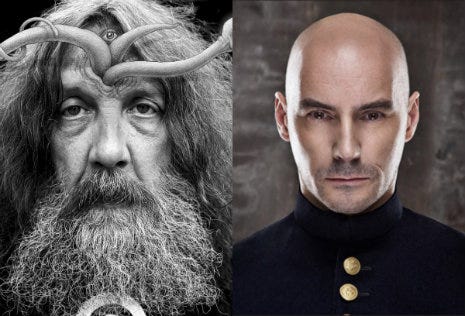
There is also something deeply generational in the way Major Arcana thinks about all this. Simon belongs to an older cohort, formed by the 1980s and 1990s, when occult‑minded comic writers like Alan Moore and Grant Morrison tried to fuse magic and literature inside comics, turning stories into sigils and superhero narratives into working grimoires and prophecies. Simon is very clearly written in their shadow: a “magus‑artist” who believes his work contains hidden structures of revelation, that if readers decode his symbols correctly, they will see through the world and maybe even help to fix it.
The novel understands the seduction of that posture. It gives Simon genuine intelligence, charisma, and a bibliography thick with apocrypha and occult hints, but it is ultimately a criticism of the hubris underneath. Again and again, Pistelli shows the fallout of magic practiced as ego obsession: Simon’s experiments with drugs and ritual perception, his tarot‑infused comics, his private cosmology all breed monsters and catastrophe for other people, not enlightenment. Magic in this book is never just neutral technique. Practiced in the selfish pursuit of power, genius, or vindication, it starts to look like a Faustian deal— an agreement to spend other people’s souls as collateral for your own revelation. The drive to know the truth once and for all, or to repair the world through a single blazing revelation, becomes its own big problem. It calls itself illumination, but it functions like extraction.
Ash belongs to a newer form of the same temptation. If Simon represents the Moore and Morrison era of ritualized comics and private gnosis, Ash is pure twenty‑first‑century digital occult: trauma narratives, manifestation culture, internet rabbit holes, online communities as covens. She also wants a master key, some theory, practice, or spell that can explain why she suffers and how to turn pain into power. As a millennial poet with one foot in each world: raised on those old comics and forums, now living on Substack; I recognized myself uncomfortably in both of them. Astrologers would call people like us Pluto‑in‑Libra and Pluto‑in‑Scorpio. We are wired to interrogate relationship, power, taboo, and to drag whatever is hidden into the light, sometimes without asking whether we are ready to live with what we have uncovered.
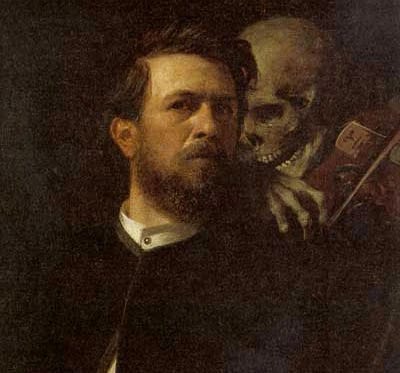
That is the context in which my own fear of “winning” started to make sense. It is not only personal cowardice. It is also the pressure of a subculture that keeps telling artists and writers that their work must be morally serious, spiritually awake, and publicly accountable all at once. We are told our words should heal, diagnose, expose, redeem, and also perform well in the algorithm. Under that pressure, it was easy for me to treat my notebook as a kind of altar and my family as acceptable collateral damage. Major Arcana does not solve that tension, but it reveals it. It shows what happens when people try to live inside a story that is too big for them, and how hard it is to climb back down without giving up on meaning altogether.
For me it is a novel that is starting to grow in importance because it captures a certain bubbling zeitgeist within the community. The fog of uncertainty has begun to thin, and with it the comfort of irony. There is less and less room to remain lukewarm. You either lean toward belief, or you drift toward a kind of death that looks like numbness, a refusal to feel what you already know. The danger is to believe that you are “chosen” or “special,” that the fate of some collective awakening sits on your shoulders. That, again, is the ego using spiritual language to keep itself in charge.
At the end of the novel Ash del Greco makes her choice. She chooses life: to live in humility with others, without trying to control the narrative, to accept being one person among many instead of a heroine of endless transformation. Simon Magnus receives his own humble pie, reflecting on the futility of his previous successes and accepting that, in the end, all of the awakening and revelation has led him back where he started: alone. Both step back from the fantasy of being the one who sees and scripts everything. In the end we are all creators of the narrative. We can build on the assumption that we are special, chosen and alone, or from a colder, more sober place: the place of weathered branches and water frozen still, a cold hell not as an eternal destination but as one facet of the tale, one moment in time. Things age and they wither, and in the end, everything dies.
But Death is not the end. In tarot and in life, Death is the card that says: this version of you cannot go on, but something else can. After death begins a different life, the life of the spirit. It can be heaven or it can be hell, or it can be anything in between. Major Arcana does not celebrate the artist who sets out to hack reality and change the world through art. It pays attention to the collateral. It shows that magic is really about what you are willing to give up, and that when you use spiritual or artistic tools in the service of your own mission, at the expense of everyone around you, the price is always higher than you think. What the novel offered me instead was something smaller and harder: presence and humility. It asked me to accept my Death card, to let the fantasy of the chosen writer die, and to step away from the tower of my own self‑importance so I could try, instead, to be a witness among the living, starting with the people in my own house, the ones who need me the most.
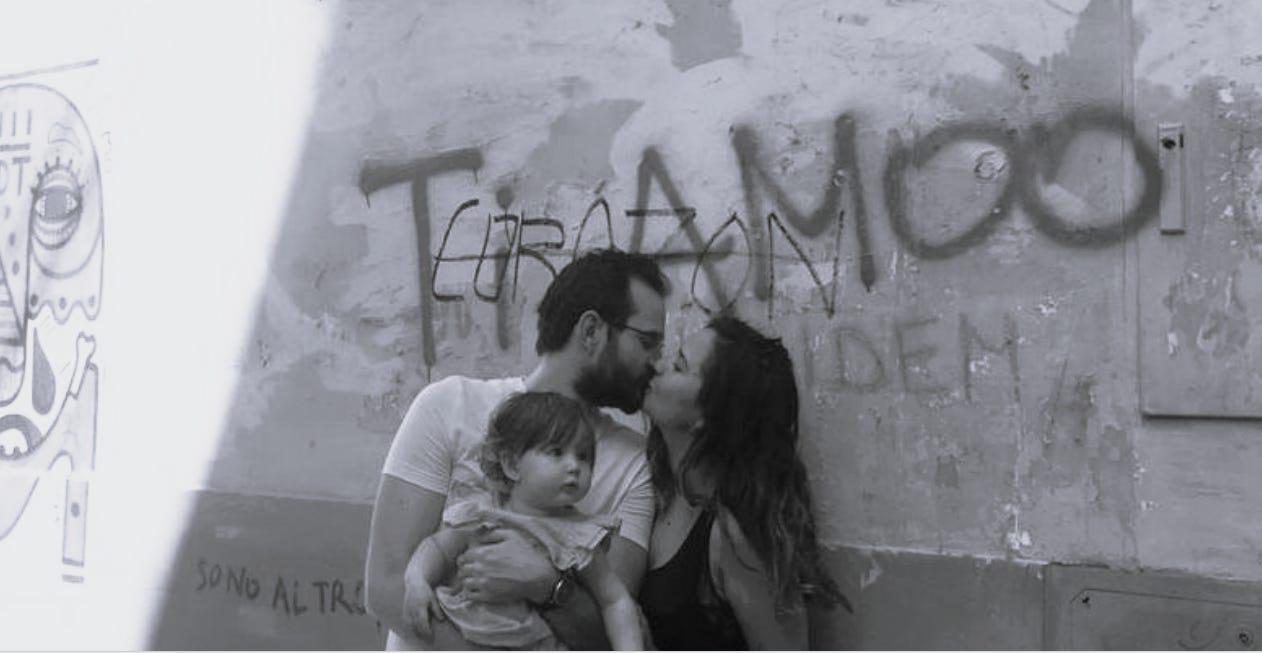
I wrote this piece not only for myself, but for every creator who feels the pull to turn their work into a world‑saving mission. Many of us are here on Substack with a sense of urgency, watching the world fall apart in our news feeds, watching art and meaning feel under attack, and we start to believe the entire weight of repair rests on our shoulders. It might be worth asking what happens if we loosen that belief. We can keep writing, but perhaps let go of the fantasy that the writing will fix the world or fix us; approached from that egoic place, it may be more likely to break things than heal them. I am starting to suspect that true awakening is less a lightning bolt of transcendence and more a long, unglamorous practice of taking responsibility for our circumstances, our choices, the people we actually touch. In the end we are all dust. Our lives can only be lived once, and we only get one chance to love the people in them. If anything matters, it might be that.
It is so wonderful to see your "voice" present in both your poetry and your non-fiction. I love when I read something and go "Oh this is so _____!" This was very "Adrian" haha. Really great essay! I got a lot out of it and it makes your poem "You" feel that much more powerful.
That pull between creating something meaningful and still showing up for the people right in front of you is something many of us recognize. It takes courage to say it.